

Herbicide resistance detection in weedy grasses across the wheat-producing counties in Oklahoma
Herbicide-tolerant Clearfield Plus® and CoAXium® wheat varieties represent flexibility in timing of weed control and reduction in crop injury compared with other herbicides available for wheat production. Previous and current field trials indicate optimal weed control when applied at the correct application rate with the right timing and in the absence of herbicide-resistant weeds. However, overreliance on a single herbicide mode of action, regardless of the system, can result in resistant weeds. Research in 2024-2025 aimed at identifying herbicide-resistant grasses across the wheat-growing regions of Oklahoma for the purposes of providing updated resistance maps and formulating research questions that include diversified weed management options to reduce the spread of resistance. Slowing the rate of resistance will allow trademarked technologies, such as the Clearfield Plus® system, to remain effective in the long term.
Weedy grass samples were collected from 32 wheat-producing counties in the spring and summer of 2024. Those counties included Alfalfa, Beaver, Blaine, Caddo, Canadian, Cimarron, Comanche, Cotton, Creek, Custer, Dewey, Garfield, Grady, Grant, Greer, Harper, Jackson, Kay, Kingfisher, Kiowa, Lincoln, Logan, Noble, Oklahoma, Payne, Roger Mills, Stephens, Texas, Tillman, Washita, Woods and Woodward counties.
At least three samples were collected from each county, with 5 miles between samples to capture different environments, soil types, farming practices, etc. Samples included grower-submitted harvest samples from fields suspected to contain resistance and from roadsides to capture susceptible populations for comparison. There were a total of 1,500 plant samples tested; half of the samples were Italian Ryegrass (Lolium multiflorum), the remaining samples consisted of Ryebrome/true cheat (Bromus secalinus), Rescue grass (Bromus catharticus) and Jointed goatgrass (Aegilops cylindrica). Downy brome/cheatgrass (Bromus tectorum) was also collected but not yet tested due to issues with germination. These have been reported through grower surveys and word-of-mouth as the most problematic grassy-weed species in wheat systems at present.
Clearfield Plus® uses Beyond® herbicide (active ingredient imazamox, group 2 mode of action), and CoAXium® uses Aggressor®AX herbicide (active ingredient quizalofop, group 1 mode of action). In our research, we tested these active ingredients as well as RoundUp PowerMax® (active ingredient glyphosate, group 9 mode of action). Table 1 lists application rates for each product.
| Herbicide | Active Ingredient | Mode of Action Group | Application Rate | Adjuvant |
|---|---|---|---|---|
| Aggressor®AX | quizalofop | 1 | 24 fl oz/ acre | 1% COC |
| Beyond® | imazamox | 2 | 12 fl oz/ acre | 1% COC |
| PowerMax® | glyphosate | 9 | 40 fl oz/ acre | 1% AMS |
COC – Crop oil concentrate added at a 1% volume/volume mix; AMS – Ammonium sulfate added at a 1% volume/volume mix
Seeds were planted in pots and sprayed in an enclosed spray chamber once they reached the 2-3 leaf stage with a single active ingredient. Plants were monitored daily for injury, but final injury assessment was determined 21 days after spraying to ensure ample time for herbicide activity within the plants. Plants were grown in a greenhouse under ideal conditions for growth and development.
Herbicide-resistant Italian Ryegrass was detected in 19 of the 32 counties sampled, with 77% of the populations resistant to one, two or all three herbicides tested, i.e., populations were resistant to both single- and multiple-active ingredients in different mode of action groups. The map below illustrates the resistance detected across the sample area.
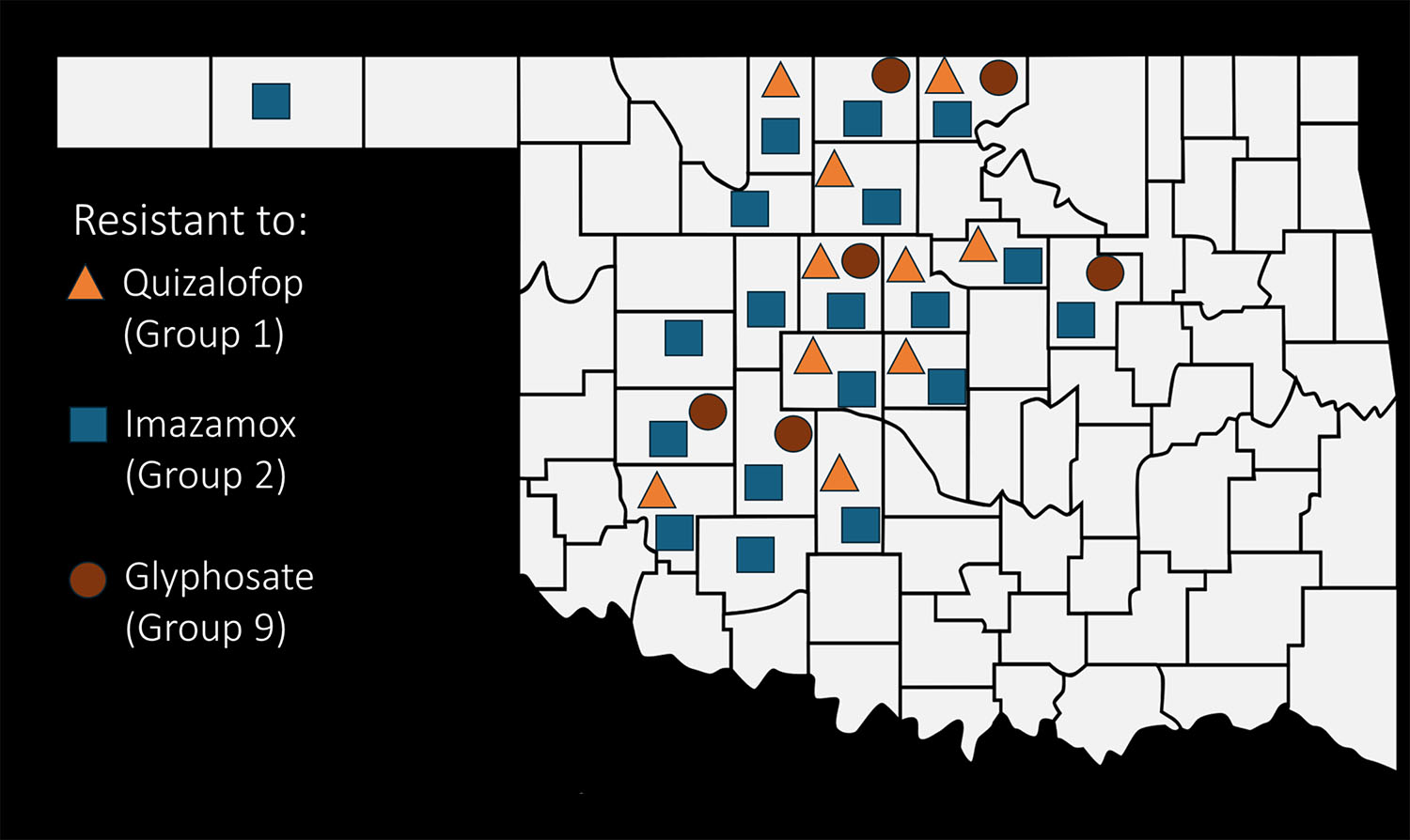
Figure 1. A map of Oklahoma with county-level resistance detection of quizalofop, imazamox and glyphosate in Italian Ryegrass.
- Triangles represent quizalofop resistance, detected in 10 counties: Alfalfa, Canadian, Garfield, Grady, Kay, Kiowa, Kingfisher, Logan, Oklahoma and Payne.
- Squares represent imazamox resistance, detected in 19 counties: Alfalfa, Blaine, Caddo, Canadian, Comanche, Creek, Custer, Garfield, Grant, Grady, Kay, Kiowa, Kingfisher, Logan, Major, Oklahoma, Payne, Texas and Washita.
- Circles represent glyphosate resistance, detected in six counties: Caddo, Creek, Grant, Kay, Kingfisher and Washita.
Herbicide resistance in Ryebrome/true cheat, Rescue grass, and Jointed goatgrass was also present but less prevalent compared with Italian Ryegrass (Table 2). This could be due to the lower sample number compared with Italian Ryegrass rather than an absence of resistance.
The number of herbicide-resistant samples for each grass species compared with the number sampled from each county. Cells with no data indicate that the species was not sampled from that county. Cells with an entry of 0 indicate resistance was not detected for that herbicide-weed combination.
| County | Glyphosate | Quizalofop | Imazamox |
|---|---|---|---|
| Alfalfa | 0/2 | 0/2 | 0/2 |
| Beaver | 1/2 | 0/2 | 0.5 |
| Beckham | 0/1 | 0/1 | 0/1 |
| Blaine | 0/2 | 0/2 | 0/2 |
| Caddo | 0/1 | 0/1 | 0/1 |
| Carter | - | - | - |
| Cimmaron | |||
| Comanche | 0/1 | 0/1 | 0/1 |
| Creek | 0/1 | 0/1 | 1/1 |
| Custer | 1/3 | 0/3 | 2/3 |
| Dewey | 1/2 | 0/2 | 2/2 |
| Ellis | 0/1 | 0/1 | 0/1 |
| Garfield | - | - | - |
| Grant | 0/1 | 0/1 | 1/1 |
| Greer | 0/2 | 0/2 | 0/2 |
| Harper | 1/1 | 1/1 | 1/1 |
| Jackson | - | - | - |
| Kay | 1/3 | 0/3 | 1/3 |
| Kingfisher | - | - | - |
| Kiowa | - | - | - |
| Logan | - | - | - |
| Major | 0/1 | 0/1 | 0/1 |
| Noble | 0/4 | 0/4 | 0/4 |
| Oklahoma | 0/1 | 0/1 | 1/1 |
| Payne | 0/1 | 0/1 | 0/1 |
| Roger Mills | 0/1 | 0/1 | 0/1 |
| Texas | 0/1 | 0/1 | 1/1 |
| Tillman | 1/2 | 0/2 | 1/2 |
| Washita | 0/3 | 0/3 | 1/3 |
| Woods | 0/1 | 0/1 | 0/1 |
| Woodward | 1/2 | 0/2 | 2/2 |
| County | Glyphosate | Quizalofop | Imazamox |
|---|---|---|---|
| Alfalfa | 1/1 | 1/1 | 1/1 |
| Beaver | - | - | - |
| Beckham | - | - | - |
| Blaine | 0/1 | 1/1 | 1/1 |
| Caddo | |||
| Carter | 1/1 | 1/1 | 1/1 |
| Cimmaron | 0/1 | 1/1 | 1/1 |
| Comanche | 1/1 | 0/1 | 1/1 |
| Creek | - | - | - |
| Custer | - | - | - |
| Dewey | - | - | - |
| Ellis | - | - | - |
| Garfield | - | - | - |
| Grant | - | - | - |
| Greer | - | - | - |
| Harper | - | - | - |
| Jackson | 2/2 | 2/2 | 1/2 |
| Kay | - | - | - |
| Kingfisher | - | - | - |
| Kiowa | - | - | - |
| Logan | - | - | - |
| Major | - | - | - |
| Noble | - | - | - |
| Oklahoma | - | - | - |
| Payne | 2/2 | 2/2 | 2/2 |
| Roger Mills | |||
| Texas | 0/1 | 1/1 | 1/1 |
| Tillman | - | - | - |
| Washita | - | - | - |
| Woods | - | - | - |
| Woodward | - | - | - |
| County | Glyphosate | Quizalofop | Imazamox |
|---|---|---|---|
| Alfalfa | - | - | - |
| Beaver | - | - | - |
| Beckham | - | - | - |
| Blaine | - | - | - |
| Caddo | 0/1 | 0/1 | 0/1 |
| Carter | - | - | - |
| Cimmaron | - | - | - |
| Comanche | - | - | - |
| Creek | - | - | - |
| Custer | - | - | - |
| Dewey | - | - | - |
| Ellis | - | - | - |
| Garfield | 0/2 | 0/2 | 0/2 |
| Grant | - | - | - |
| Greer | - | - | - |
| Harper | - | - | - |
| Jackson | - | - | - |
| Kay | - | - | - |
| Kingfisher | 0/2 | 0/2 | 1/2 |
| Kiowa | 0/1 | 0/1 | 1/1 |
| Logan | 0/1 | 0/1 | 0/1 |
| Major | - | - | - |
| Noble | - | - | - |
| Oklahoma | 0/1 | 1/1 | 0/1 |
| Payne | - | - | - |
| Roger Mills | - | - | - |
| Texas | - | - | - |
| Tillman | - | - | - |
| Washita | 0/3 | 1/3 | 0/3 |
| Woods | - | - | - |
| Woodward | - | - | - |
Previous research identified pinoxaden (group 1 mode of action) resistance in Italian Ryegrass (2017) and Sulfosulfuron, imazamox, pyroxsulam and propoxycarbazone (all group 2 mode of action) in Ryebrome/ True cheat (2009). Future research aims to identify which active ingredients within these group 1 and 2 modes of action remain viable, i.e., additional modes of action (group 15) pyroxasulfone containing and pre-emergent chemistries that could be used in wheat, as well as additional cultural and mechanical weed control strategies for reducing the spread and decreasing the presence of these resistant populations over time.