

OSU laboratory turns samples into decisions
Friday, July 31, 2026
Media Contact: Alisa Gore | Office of Communications & Marketing, OSU Agriculture | 405-744-7115 | alisa.gore@okstate.edu
OSU laboratory turns samples into decisions
Media Contact: Alisa Gore | Office of Communications & Marketing, OSU Agriculture | 405-744-7115 | alisa.gore@okstate.edu
Boxes frequently arrive at Oklahoma State University’s Soil, Water and Forage Analytical Laboratory with questions tucked inside.
A farmer wants to know how much fertilizer to apply before planting. A rancher needs to determine whether hay is safe for cattle. A homeowner is trying to understand a lawn or garden problem. A researcher needs thousands of samples analyzed for a long-term study.
By the time those samples leave the lab, they have become more than soil, water, forage or animal waste. They have become data that helps Oklahomans make decisions.
“Our mission is not just to run samples,” said Bee Khim Chim, director of the laboratory. “It’s to translate analytical science into practical decisions that improve production, protect the environment and build a stronger agricultural community.”
Established in 1967 as a centralized laboratory for OSU Extension, the analytical laboratory now supports all 77 Oklahoma counties. Since its establishment, it has received samples from clients in 38 states, but its primary responsibility remains Oklahoma agriculture.
In 2025, SWFAL analyzed 66,765 total tests, including 17,801 research samples. The lab’s work spans soil fertility, water, salinity, forage, soil texture, animal waste and research testing.
Clients can submit samples through OSU Extension county offices and access information through the lab’s customer portal. County offices can print or email reports and make recommendations based on local needs. County Extension educators can instruct clients on proper sample collection and explain how to interpret analysis results. Samples are logged into the lab’s system, dried, ground, extracted, filtered and analyzed. Recommendations are tied to research from OSU specialists, who conduct field trials, test fertilizer rates and evaluate crop response.
“For a routine soil analysis, we usually get results out within two business days. We try to get results out as soon as possible,” said Kendal Henderson, SWFAL lab manager. “Our goal is to educate the educators, and the educators teach the clients. We try to make the process as simple as possible and sampling as consistent as possible.”
Chim became director in January 2025, and Henderson has worked with the lab for 18 years, managing much of its operations. Barbara McCray handles data and financial management as well as software issues. The team also includes technicians and undergraduate and graduate students.
A statewide service built on accuracy
The most important quality control step is often the way a sample is collected. A soil sample should include multiple subsamples from across a field or area. Forage, water and animal waste samples also must be carefully collected.
“If the original sample is not representative of the entire landscape, our analysis can only tell them what is in that sample,” Henderson said.
Chim said consistency matters. Sampling depth, timing and method all affect results, which is why county Extension educators play such an important role in helping clients follow protocols.
“We are only as good as the sample we receive,” Chim said.
Inside the lab, an Inductively Coupled Plasma analyzer, flow injection analyzers, combustion analyzers, fiber analyzers, an automated titrator and a Near Infrared Reflectance Spectroscopy support testing needs.
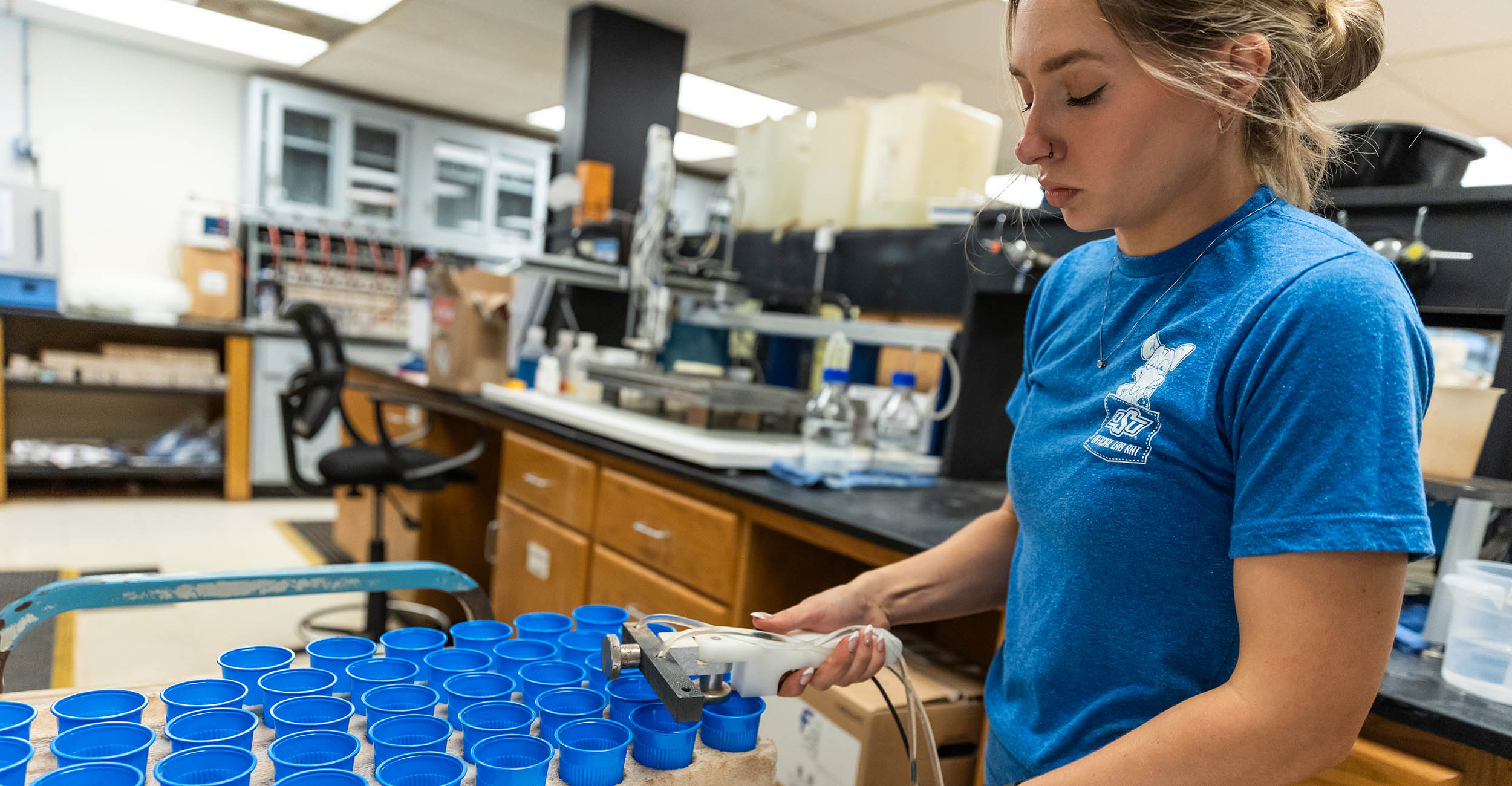
Automated technology enables SWFAL staff to operate several instruments at once, but the process remains hands-on. Samples must still be weighed, scooped, mixed, filtered, moved, checked and approved by trained staff members.
Near Infrared Reflectance Spectroscopy, one of the lab’s newer tools for forage analysis, scans a forage sample in about 60 seconds to estimate dry matter, protein, lignin and fiber.
“What takes several days to do in a traditional wet chemistry lab can take 60 seconds here,” Henderson said.
This is especially important during drought, when forage nitrate levels can become a concern for livestock.
“If there is drought, nitrate can accumulate in forage, and producers need to know whether their hay is safe to feed cattle,” Chim said.
Practical recommendations for Oklahoma conditions
The laboratory does not simply return numbers. Its reports help connect laboratory analysis to field-level recommendations based on Oklahoma research, local field calibrations and years of Extension data, which matters because soil, crops, weather and growing conditions vary by state and region.
“If producers know what they have in the soil, they do not over-fertilize, which protects water and the environment,” Chim said.
Forage testing can help producers evaluate feed quality; animal waste testing can help determine fertilizer value before it is applied in the field; and water testing can help clients better understand household, irrigation or livestock water.
“Our recommendations are based on science,” Henderson said. “If someone sent a sample to a private lab, they might pay three times as much and wait longer.”
Keeping the testing service affordable is part of the lab’s mission, with more than 90% of the lab’s revenue generated from testing fees, which help cover personnel, equipment and other day-to-day costs. The result is a laboratory that functions as both a high-tech analytical facility and a practical service unit.
“Our goal is not only to analyze more samples, but to remain a trusted first choice for Oklahoma,” Chim added. “The Soil, Water and Forage Analytical Laboratory is where science meets service.”
OSU plans to build a new Agronomy Discovery Center, which will serve as the home for the testing lab. Updated facilities will create a modernized space for analytical testing and collaboration across Oklahoma. For more information on the lab, visit the soil testing website.
Story By: Jemella Zhang | jemella.zhang@okstate.edu
Story By: Jemella Zhang | jemella.zhang@okstate.edu