

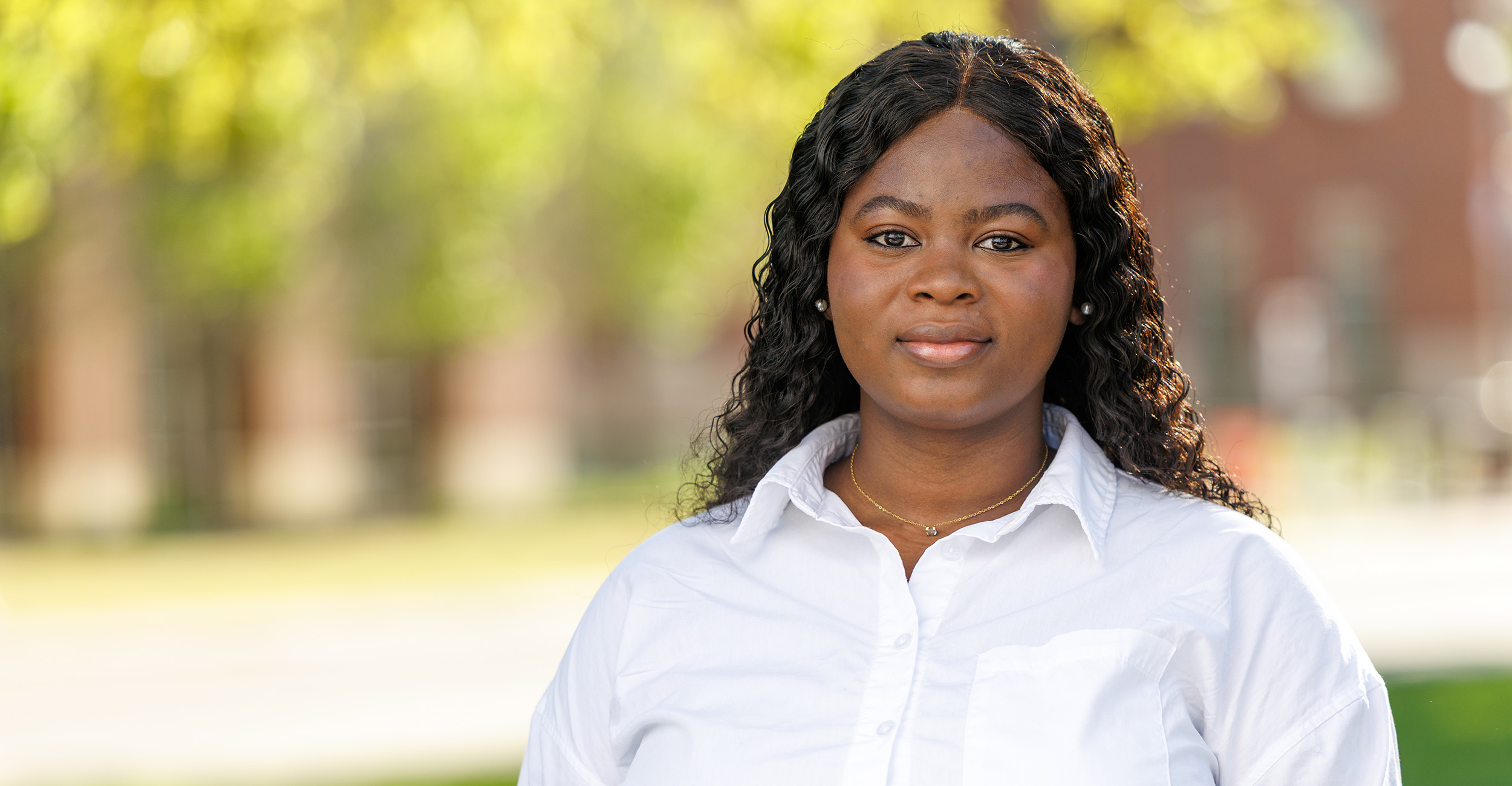
OSU Ph.D. student advances precision agriculture through global fellowship
Wednesday, February 11, 2026
Media Contact: Dean Ruhl | Communications and Media Relations Specialist | 405-744-9152 | dean.ruhl@okstate.edu
When Aicha Biaou left her home in Togo, West Africa, to pursue her Ph.D. in plant and soil science at Oklahoma State University, she carried a vision for the future of farming. Today, her research in precision agriculture is helping bridge the gap between technology and sustainability in the field.
Biaou’s path toward agricultural science began unexpectedly. Growing up in Togo, she was surrounded by a culture that valued traditional career paths. Yet a conversation with a family member would shift her perspective and ignite a lifelong interest in agriculture.
“Where I come from, everyone tells their children to study medicine or engineering,” she said. “Agriculture isn’t seen as a first choice. But my uncle, who is an agronomist, told me agriculture remains the future of the world, because people will always need to eat.”
That conversation changed the course of her life. After earning her bachelor’s and master’s degrees at the Agronomic and Veterinary Institute Hassan II in Morocco, Biaou began looking for opportunities to continue her research. Through connections and mentorship, she met Steve Phillips, now her faculty advisor at OSU, who encouraged her to apply for the doctoral program and later, the Schlumberger Grant.
“What began as a vision became reality through meeting the right people and finding the right place,” she said. “My advisor has had an incredible impact on me, taking on the role of mentor and guide all in one. Students under his advisement turn to him for everything, and he always knows when to challenge us and when to offer support. He’s the kind of scientist we all aspire to be.”
Phillips describes Biaou as a deeply curious and driven researcher who approaches challenges with intention and persistence.
“She’s a very curious person,” Phillips said. “When she’s presented with a problem, she’ll look at it from several different perspectives and try to really understand what she needs to do before she starts working. She always loves learning.”
According to Phillips, Biaou is also a self-starter who consistently pushes herself to acquire new skills.
“If she needs to look at her data in a certain way and needs a new software program or a new code written in another language, she’ll take the time and learn it,” he said. “She really leaves no stone unturned when it comes to her projects.”
Biaou’s research focuses on precision agriculture, a technology-driven approach that utilizes data, sensors and satellite imagery to optimize how farmers manage resources such as water, fertilizer and seed. She conducts her fieldwork in the Oklahoma panhandle, studying irrigated corn systems to evaluate how different rates of nitrogen, irrigation and planting density affect yield and efficiency.
“The big question farmers face is whether the inputs they’re putting into their crops, like water, fertilizer and seed, are truly benefiting them,” she said. “Are they applying too much or too little? Our research looks at how those inputs work together to influence yield and profitability.”
Her work includes flying unmanned aerial vehicles equipped with various sensors to measure plant health and stress.
"I’m a licensed drone pilot, and I use multispectral and thermal imagery to detect nitrogen and water stress in corn,” she said. “The aim is to help farmers distinguish between the two stresses and make precise management decisions.”
Phillips said Biaou’s strength lies in her ability to integrate complex data and translate it into useful information.
“She’s very strong in statistics, multiple regression and machine learning techniques,” he said. “She can figure out what the data are really saying. She works with images, remote and proximal sensing data, and physical soil or plant tissue samples, and she has a very good skill set to put all of that together.”
Biaou measures nitrous oxide emissions from her research plots to evaluate environmental impacts, a component that connects science with agricultural policy. Through her work, Biaou hopes to ultimately make farming more efficient and sustainable.
“Every dollar a farmer invests in the field should work harder,” she said. “If we can achieve the same yield with less water or fertilizer, that saves both money and resources. That’s the heart of precision agriculture.”
In 2025, Biaou was awarded the Schlumberger Foundation Faculty for the Future Grant, a prestigious program supporting women in STEM research worldwide. The recognition, she says, is deeply meaningful.
“It’s not very common for a graduate student to receive a grant like this, especially an international student,” Biaou said. “It means a lot to me. It shows that my work is being seen and that someone recognizes the importance of what I’m doing.”
Phillips said the recognition reflects Biaou’s dedication, leadership and character as much as her research.
“Beyond being an exceptional scientist, she’s one of the leaders among our doctoral students,” he said. “She’s always willing to go to the farm and grind soil and do the menial tasks. There’s nothing beneath her.”
Phillips attests that Biaou’s presence elevates the entire program.
“She’s one of those people who makes everyone around her better,” he said. “She’s just a wonderful asset to the program.”
For Biaou, education, mentorship and strong support systems are essential components of success in science, particularly for women in agriculture. The Schlumberger Foundation’s model reflects that belief, pairing grantees with mentors and alumni from around the world who invest in their long-term growth.
“They don’t just give you the grant and walk away,” she said. “They want you to succeed. They want you to continue being excellent and to achieve your goals.”
After completing her Ph.D., Biaou plans to continue pursuing research, possibly in combination with teaching, in the field of soil science and precision agriculture. For now, she remains focused on her research, her mentoring relationships and the opportunity to represent women in agricultural science.
“If you really love what you’re doing, be bold, be courageous, and be excellent,” she said. “It’s not easy, but when you give your all, life gives back. It’s better to say, ‘I tried and failed,’ than to live with the regret of never trying.”
Story By: Jacy Gehlsen | jacy.gehlsen@okstate.edu